What if a new starter isn't working out after January 2027?
From 1 January 2027, staff can claim unfair dismissal after six months. How to run probation so the decision lands in time.


In short
- From 1 January 2027, employees in England, Scotland and Wales can claim unfair dismissal after six months' service instead of two years. That includes people already on your payroll.
- You can still end someone's employment, during probation or after it. What changes is how you do it. Once someone has six months' service you need a fair reason, a fair process and the notes to show both. A week's notice counts towards the six months, so that applies to any decision made from five months and three weeks.
- Probation is not a legal status. The right comes from length of service, and protection against discrimination and the other day-one rights apply throughout.
- What works: regular check-ins, concerns raised at the time, the outcome confirmed in writing and a short note of every conversation.
On this page 15 sections
- What changes on 1 January 2027?
- When do we have to decide by?
- Can we still let someone go during probation?
- So what is probation for?
- Set people up for success before probation starts
- The quickest fix: your managers
- What does a probation without surprises look like?
- How formal does the ending have to be?
- What if we need more time?
- What about time off during probation?
- Should our probation still be six months?
- How do we keep records without drowning in admin?
- What about people already past six months?
- Quick answers
- Who keeps track of all this?
Five months in, the new hire still isn't right. Until now, most small business owners in that spot could end things with little thought of a tribunal, because unfair dismissal protection only started after two years' service. From 1 January 2027 it starts after six months, and that includes people already on your payroll.
The problem we see most often with clients is older than the law change. It is how probation has been run up to now.
If you already support new starters closely through probation, tell them how they're doing and confirm it when they pass, you won't need to change much.
It's a different story if any of this sounds familiar:
- people rarely hear that they've passed, because nobody remembers to tell them
- one manager holds the reviews and confirms the result, and another lets the date go by
- someone is let go during probation without warning, so the first time they hear there's a problem is the meeting where they lose their job
None of that is unusual in a small business. But under the new rule each of those habits becomes a bigger problem than it used to be, because once someone has six months' service the decision has to be fair, and you need the notes to show it.
The short answer: you can still end someone's employment, during probation or after it. What changes is how you do it, and the records you need. From 1 January 2027, anyone with six months' service can claim unfair dismissal, so from that point you need a fair reason and a fair process. The law counts a week's notice towards those six months, even if you pay the person for that week instead of having them work it (pay in lieu of notice). So if you want to decide while the simpler rules still apply, the decision, the conversation and the notice need to be done before the person reaches five months and three weeks' service. Either way, the outcome should never come as a surprise to the person.
The quick version:
- decide before five months and three weeks, and aim for month five
- tell the person how they're doing all the way through
- tell them in writing when they pass
- write everything down
- make sure whoever manages new starters can give clear, regular feedback
What changes on 1 January 2027?
For dismissals that take effect on or after 1 January 2027, in England, Scotland and Wales:
- the qualifying period for ordinary unfair dismissal falls from two years to six months
- the cap on the compensatory award is removed
- the right to ask for written reasons for dismissal starts at six months instead of two years
The date that counts is the day employment ends, not the day you give notice. If you give notice in December and it runs out in January, the new rules apply.
Each person's six months runs from their own start date, not from January. So anyone with between six months' and two years' service on 1 January 2027 gains protection that day. A few examples:
| Started with you | Reaches six months' service | Protected from |
|---|---|---|
| March 2026 | By the end of September 2026 | 1 January 2027 |
| July 2026 | Between the end of December and the end of January | 1 January 2027, or the day they reach six months if later |
| October 2026 | By the end of April 2027 | The day they reach six months |
| January 2027 | By the end of July 2027 | The day they reach six months |
When do we have to decide by?
To decide under the simpler rules: before the person reaches five months and three weeks' service, and earlier in practice. After that you can still end someone's employment, but it has to be a fair dismissal, with a fair reason, a fair process and the notes to show both.
Once someone has worked for you for a month, the legal minimum notice is one week. That week counts towards their length of service whether they work it or not. Government guidance says the same applies even if the notice isn't given at all (the rule is in section 97 of the Employment Rights Act 1996). So:
- if you pay in lieu of notice, the week still counts. Ending someone's employment with immediate effect a few days before six months can still give them six months' service.
- if they work their notice, their employment ends when the notice ends. If your contract gives more than a week, all of it has to finish before the six-month point.
Count the days for the person concerned, because it is close: the week has to end before the last day of their sixth month with you.
(The usual exception is a genuine gross misconduct dismissal, where no notice is due. That's rare in probation, and worth getting advice on if that's where you are.)
That is the legal deadline. In practice you need more room than that, because meetings slip. Someone's off sick, you're away and the review moves by a fortnight. So book the outcome meeting for around month five.
Can we still let someone go during probation?
Yes, you can still dismiss someone during probation. Probation has never been a legal status: there's no legal requirement to have one, it can be any length and the Employment Rights Act 2025 doesn't change that. So the new rule doesn't touch probation itself. What gives someone unfair dismissal protection is their length of service, not whether they've passed probation.
Once the new rule starts, someone with less than six months' service can't bring an ordinary unfair dismissal claim (until then the threshold is still two years). But some protections apply from day one:
- discrimination: ending someone's job because of a protected characteristic, such as pregnancy, disability, race, sex or age. There's no qualifying period and no cap on compensation.
- a complaint or request the law protects: if someone has complained about discrimination or harassment, raised a safety concern or blown the whistle, dismissing them soon afterwards can be unlawful from day one. The same goes if they have asked for something the law gives them, such as flexible working, the minimum wage or their holiday. Pregnancy, maternity and family leave are protected in the same way.
- the contract: if you don't give the notice they're owed, that's a breach of contract.
So "they're on probation" is never the whole answer. The question is why you're ending it, and whether anything on that list could be part of the reason. If it could, get advice before you act.
Even where none of it applies, Acas describes dismissal during probation as a last resort, after support or an extension, and says to follow a fair procedure and give the reasons in writing.
So what is probation for?
It is a trial that runs both ways. You find out whether the person suits the job and the business, and they find out whether the job and the business suit them. And because probation is your own term in the contract, you decide how to use it. Its length and conditions go in the written statement, so set them out before the person starts.
Three ways employers use it:
- shorter notice. Many contracts set a shorter notice period during probation, for example a week on either side, so either of you can end it quickly if it isn't working. It can't be less than the legal minimum, which is one week from either side once someone has worked for you for a month.
- benefits that start when probation is passed. Extras you choose to offer, such as company sick pay above the statutory amount, private health cover or a bonus scheme, can wait until then if the contract says so. What the law gives can't wait: the minimum wage, paid holiday and Statutory Sick Pay all apply from day one. A workplace pension sits in between. You can postpone enrolling someone for up to three months and no longer, you have to write and tell them, and if they ask to join sooner you have to put them in.
- holiday limited to what they've built up. For someone on regular hours, you can use an accrual system in their first year: they build up one-twelfth of their annual holiday each month and can take what they've built up so far. With 28 days a year, that is seven days after three months. It is a first-year rule, not a probation one, so it works whatever length your probation is. (People on irregular hours or part-year contracts build up holiday as they work, at 12.07% of the hours they do.)
Whichever of these you use, write it into the contract and apply it to every new starter in the same way.
Set people up for success before probation starts
Probation starts on the person's first day in the job. The groundwork starts earlier. It is hard to judge someone fairly at month five if nobody told them what good looks like or showed them how to do the job, so plan their first weeks from the moment the offer goes out.
Before they start:
- put their first week in the diary: who they meet, when and why
- set up what they need on day one: equipment, logins and a desk or a van
- write down what good looks like at month three, in a few plain sentences, ready to go through in week one
- decide who trains them on what, and when
Sharing the handbook and key policies early can help people arrive ready. But if you require someone to read policies or do training before their start date, that time counts as working time for minimum wage purposes, so pay for it. For salaried staff this time can be covered by their salary, as long as their pay still works out at the minimum wage or more across all the hours they do.
In the first week:
- the meetings that matter: their manager, the people they'll work with and whoever they go to for help
- site orientation, including health and safety, for on-site roles
- training in small pieces, at the point they need it. Do it on the job where you can, and for hands-on work show them first
The quickest fix: your managers
Reviews that drift, results nobody confirms and endings that come as a surprise usually trace back to the same place: the manager was never shown how to run a probation. So in a business of up to 50 people, the quickest way to get probation right is through the person who manages the new starter. They need to know six things:
- How to give feedback: specific, clear and supportive, as close to the moment as possible. "The report was late twice this week, and here's what on time looks like" helps. "You need to step up" doesn't.
- Why the process matters: probation is how you both find out whether the job works. If nobody checks in until the end date, neither of you learns anything.
- The legal minimum: the six-month point, the notice week and the day-one protections above.
- No surprises: the person should always know how they're doing: what's going well, what isn't and what they need to work on. If the outcome is an extension or an ending, they should have seen it coming.
- When to stop and ask: if the person has made a complaint, asked for flexible working or another legal right, told you they're pregnant or mentioned a health condition, get advice before deciding anything.
- To write it down: every check-in, every concern, every outcome.
Giving good feedback is a skill, and most managers in small businesses were never shown how. We train managers to give feedback that's specific, clear and kind. It is part of our Training and Development work.
What does a probation without surprises look like?
Regular check-ins, and notes you'd be comfortable for someone else to read. How often you meet is your decision. It depends on the role, how much support the person needs and what you can reasonably offer. Check-ins can be:
- weekly, fortnightly or monthly
- in person or remote
- a one-to-one, or part of a catch-up your team already has, such as a stand-up
If your team already has a pattern, use it. What matters is that you stick to it for every new starter, and that it runs both ways: they can ask questions and hear how they're doing, and you hear how it's going for them. Be open to that feedback and ask for it. Do that and you're on the right track. (Keep anything about one person's performance for a one-to-one.)
A structure to start from:
- Week one: go through the role, what's expected and what good looks like at month three. Agree how often you'll check in, and how.
- At each check-in: what's going well, what isn't and what help they need. Ask what they would change, too. Note it.
- As soon as a concern appears: raise it then, with examples, the support you'll give and the date you'll look at it again. A concern first mentioned at the final review is hard to call fair.
- The outcome meeting, before probation ends: they pass, you extend or you end it. Tell them the result in writing, whichever it is. Passing matters too: it's when they know where they stand, and it's the step most often forgotten.
- If it's ending: invite them in writing, explain the concerns, listen to their side, then decide. Confirm the decision, the reasons and the notice in writing.
The biggest mistake we see is ending someone's job in a meeting they didn't see coming. If steps 2 and 3 have happened, the outcome won't be a surprise, and that's what makes the process fair.
We've put all of this on one page for the manager: our probation review template has the check-in prompts, the outcome and room for feedback both ways. It's free, with no email to give. Print it, or type into it on screen:
Download the probation review template (PDF)
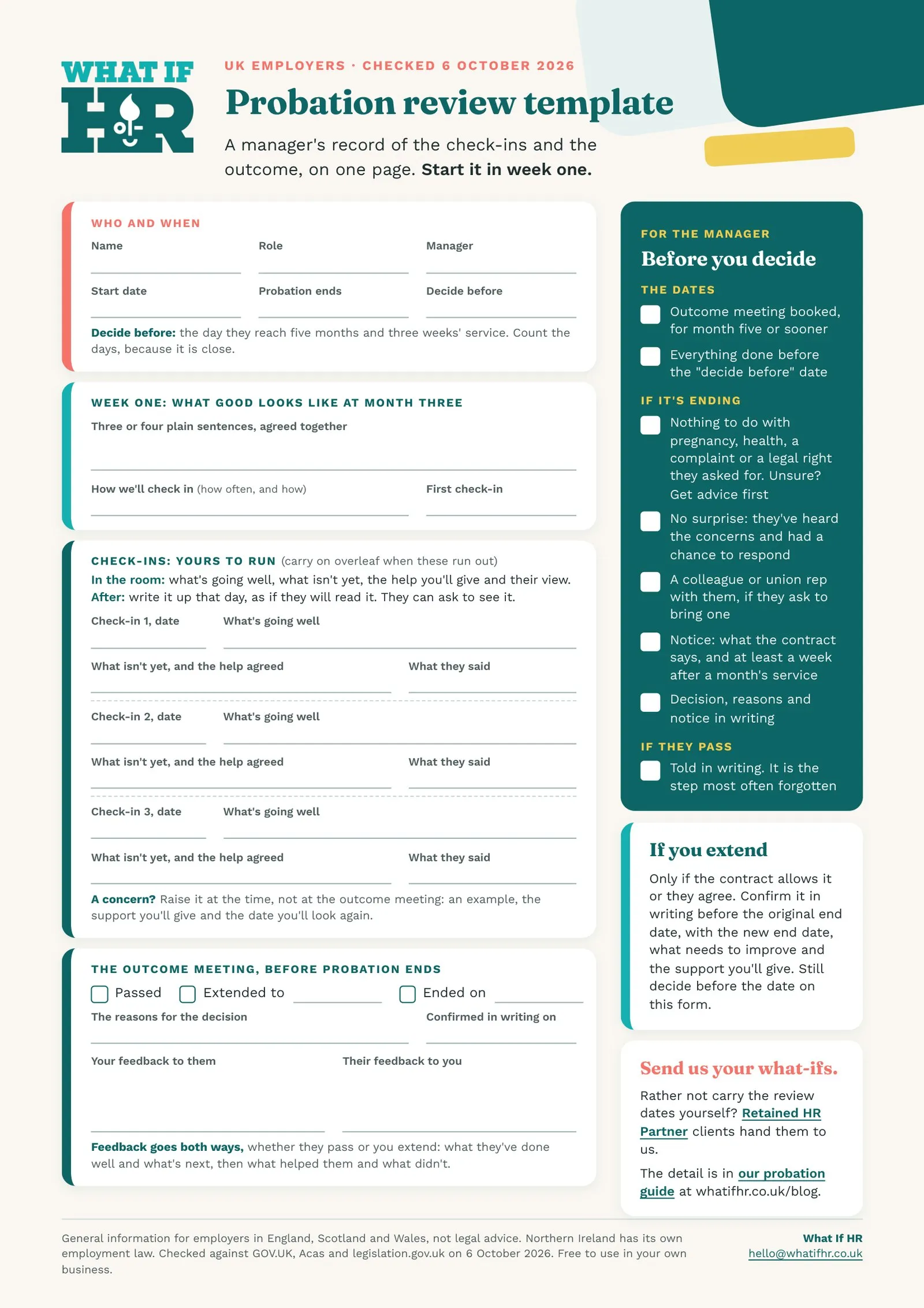
The template, on one page. Download the PDF to print, or to fill in on screen.
How formal does the ending have to be?
Less formal than a full disciplinary process, if your own policy says so. Many employers write into their disciplinary policy that the full procedure doesn't apply during probation, or can be shortened. If yours says that, you don't have to work through warnings and stages, and you don't have to offer an appeal. If it promises the full procedure to everyone from day one, follow it until you change it.
An appeal is still worth offering when a case is sensitive, or when there's any chance it is about more than failing probation.
One thing a policy can't shorten: if the person asks to bring a colleague or a trade union representative to a meeting that could end in their dismissal, the law gives them that right from day one. You aren't required to offer it, though Acas says to tell them. You can't refuse it.
From 1 January 2027 the short process is only for people with under six months' service. Once someone has six months, use the full one.
What if we need more time?
For most roles, five months is enough time to see whether someone can do the job. If you need longer, you can extend the probation, but only if the contract allows it or the person agrees. Acas says to confirm an extension in writing before the original probation ends, with the new end date, what needs to improve and the support on offer.
Keep any extension short enough to decide before five months and three weeks.
If an extension takes someone past six months' service, the rules change. They're protected from unfair dismissal, so ending their employment needs:
- a fair reason, usually capability (they can't do the job to the standard needed) or conduct
- a fair process that follows the capability or disciplinary procedure in your handbook and the Acas Code of Practice
- the reasons in writing
What about time off during probation?
Decide in advance how you'll treat it, and treat everyone the same way. The questions are yours to answer:
- how much holiday can someone take during probation?
- if they take a long holiday, two weeks or more, does the probation extend?
- does the same apply to sickness, or to any other long spell away from work?
Some employers extend by the length of the absence, so the person still gets the time and support to reach the standard the role needs. Some of our clients extend only when someone is away for two weeks or more in one go. They don't extend for odd days spread across the probation, because those still leave the person enough unbroken time to get up to speed.
You can also decide without extending. Acas gives the example of someone who performs well for four months and is then off sick for two: the four months are enough to pass them.
Whatever you choose, put it in the contract or your probation policy, so it is the same rule for everyone and nobody is surprised by it. Any extension still has to leave you time to decide before five months and three weeks.
One caution: absence linked to disability, pregnancy or family leave needs separate thought, because Acas says extensions for absence must not discriminate. Get advice before you extend or end a probation for one of those reasons.
Should our probation still be six months?
For most small teams we'd set it at three months, with the option to extend once. That is our judgement, because the law doesn't fix the length. The reason is timing: a six-month probation will end at almost exactly the point someone gains protection, which leaves no room for an extension, a delayed meeting or the notice week.
Acas notes that some technical or specialist roles need longer to assess. If that's your business, keep the longer probation and bring the decision forward to month five.
To change the length for new starters, update your contract template (our HR Documents service covers probation clauses). If you change the probation terms for someone already in post, agree it with them and confirm it in writing.
How do we keep records without drowning in admin?
Short notes are enough: the date, what you discussed, what was agreed and what happens next. Keep a note of every check-in, every concern raised, the support you offered and the outcome. If you ever need to show the process was fair, those notes are the proof.
If keeping notes is the part that slips, software can take the effort out of it. A tool that gives one-to-ones a set structure and keeps the notes in one place, such as ClarityLoop or Employment Hero, means every manager follows the same steps and nothing lives only in someone's head. Some apps can record a meeting and write up the notes. If you use one, tell the person first and explain why, and remember the recording is personal data they can ask to see.
The tool keeps the record. How the conversation goes is still down to the manager: whether it is respectful, and whether it sounds like your business at its best.
What about people already past six months?
They gain the right too. From 1 January 2027, anyone with at least six months' service can claim unfair dismissal, and that includes people who already work for you. Someone who joined you in 2025 or the first half of 2026 will have between six months' and two years' service on that day: nine months, say, or a year and a half. They gain unfair dismissal rights on 1 January, whether or not they ever had a probation review. (Anyone with two years or more has them already.)
So from 1 January 2027, ending their employment needs a fair reason and a fair process. For a conduct or performance problem, the safest route is to follow the Acas Code of Practice on disciplinary and grievance procedures in full: look into the facts, put the concern in writing, hold a meeting where they can respond and bring a companion, give them a real chance to improve, confirm the decision in writing and offer an appeal.
If you're already working through a concern with someone in that group, follow that process now and keep notes. The date that counts is when employment ends, not when you decide.
It will be harder to dismiss someone with six months' service from January, but that is not a reason to let people go just before it arrives. A dismissal hurried through to beat the date is easy to spot. If it is challenged on one of the day-one grounds above, a tribunal is likely to ask why it happened when it did, and you don't want to be answering that with nothing on paper. And if the notice runs into January, the new rules apply anyway.
The date is still a useful one to keep in mind. If you're already assessing whether someone is right for the role, and you can fairly reach that decision before then, work to it. Either way, talk to us through Employee Relations Support or to an employment solicitor before you act.
Quick answers
Is a probation period a legal requirement?
No. It's a term you choose to put in the contract. It can be any length, and the Employment Rights Act 2025 doesn't change that.
Does passing probation give someone unfair dismissal rights?
No. The rights come from length of service. Passing or failing probation doesn't move the six-month point, and neither does a review meeting that slipped.
Do we have to tell someone they've passed?
There's no legal rule, but do it, in writing. It's when they know where they stand, and it confirms any terms that change after probation, such as notice.
How much notice do we give during probation?
What the contract says, but never less than the legal minimum: one week once someone has worked for you for a month. Under a month there's no statutory minimum, so the contract decides. Gross misconduct is the exception, where no notice is due.
Do we have to give a reason?
Acas says to give the reasons in writing, and it's the fair thing to do. From 1 January 2027, anyone with six months' service can also ask for written reasons, a right that currently starts at two years.
What does "no cap on compensation" mean?
For dismissals from 1 January 2027 there's no upper limit on the compensatory award for unfair dismissal. The way it's worked out isn't changing: it's based on what the person lost, and government guidance says the vast majority of awards are well below the current cap.
How long does someone have to bring a claim?
Six months less one day for most claims. That has been the limit since 1 October 2026. Before they can claim, they have to contact Acas for early conciliation. (In Scotland, the change for breach of contract claims takes effect on 9 November 2026.)
Do people on probation get holiday and sick pay?
Yes. Day-one rights apply during probation. Holiday builds up from the first day, and since 6 April 2026 Statutory Sick Pay is payable from the first full day off sick.
What about fixed-term contracts?
Letting a fixed-term contract end without renewing it counts as a dismissal in law. So from 1 January 2027, someone whose fixed-term contract ends after six months' service can claim if the reason or the process wasn't fair.
Does this apply in Northern Ireland?
No. The six-month rule applies in England, Scotland and Wales. Northern Ireland has its own employment law.
Who keeps track of all this?
In a small team, probation usually slips for a simple reason: the review date passes while everyone's busy. By the time anyone notices, the person has six months' service and a different set of rights.
If you'd rather not carry those dates yourself, that's the kind of thing our Retained HR Partner clients hand to us. We keep track of every new starter's review dates with you, help you prepare the conversations and keep the notes in order. See how Retained HR Partner works.
Send us your what-ifs.
This is general information, not legal advice. If you're dealing with a specific situation, speak to an employment solicitor. Checked against GOV.UK, Acas and legislation.gov.uk on 6 October 2026.