
What goes on a new starter form? A free one-page template for UK employers
What to ask a new employee for, what to leave off and how the form differs from HMRC's starter checklist. With a free one-page form to print or fill in.

In short
- A new starter form is your own form for the details you need from a new employee: who they are, how to pay them and who to ring in an emergency.
- It is not a legal requirement, and it does not replace HMRC's starter checklist, which is a tax form for someone with no P45.
- Ask only for what you will use, and send it with the offer so it is back before day one.
On this page 6 sections
How do you collect a new starter's details at the moment? Bank details by text, the P45 by email, the emergency contact on a sticky note?
What if it was one page, and the same page every time?
That is all a new starter form is, and it does not need to be long. The longest starter form I have seen a client use was five pages long. It is not necessary, and you do not need all of that information. One page holds the essentials.
Here is ours, free, with no email to give. Print it, or type into it on screen:
Download the one-page new starter form (PDF)
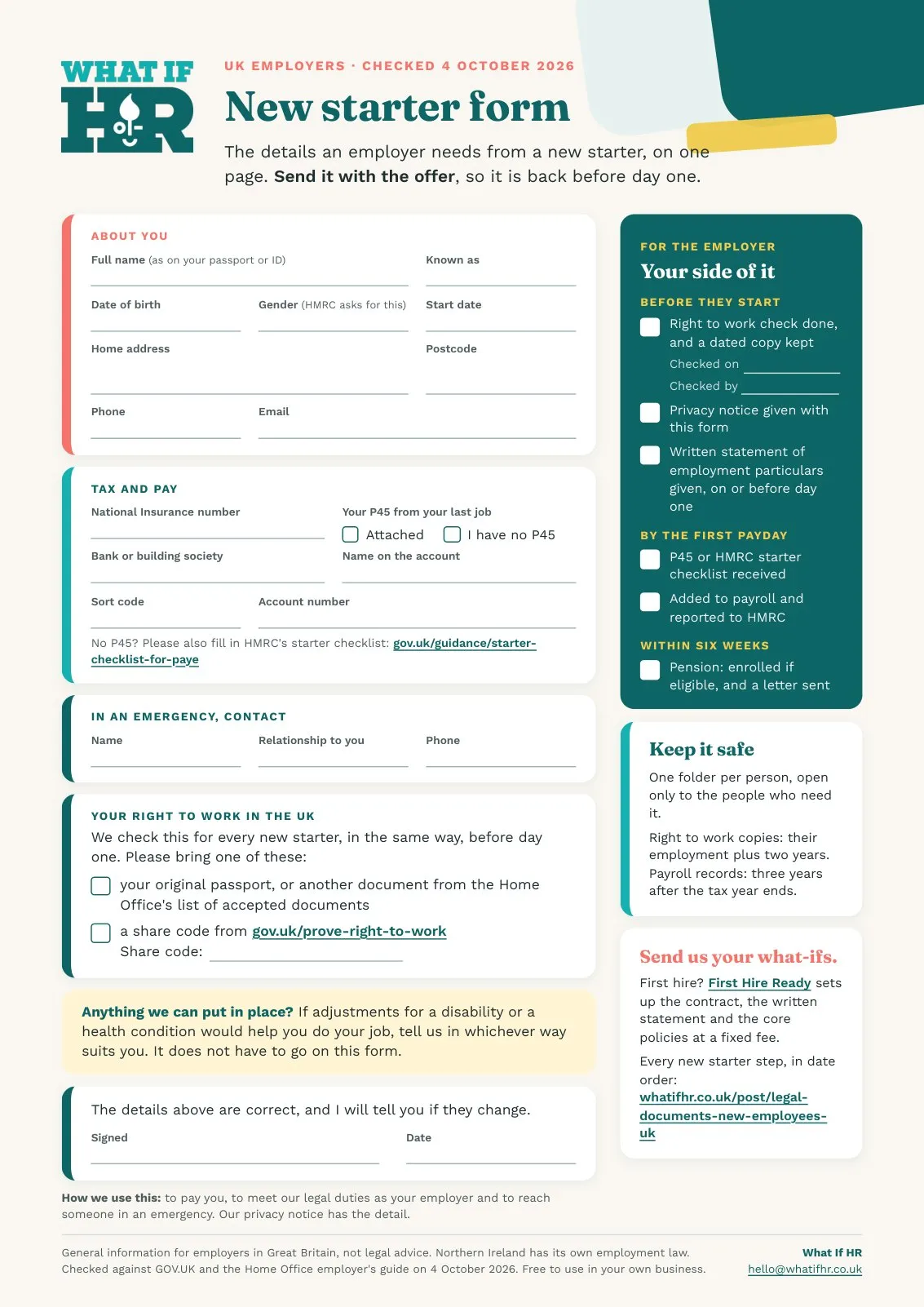
The form, on one page. Download the PDF to print, or to fill in on screen.
What a new starter form is for
It collects what you need from a new employee before their first day: who they are, how to pay them and who to ring in an emergency.
It is not a legal requirement, and no law says what goes on it. What the law does set is the information HMRC needs from you about a new employee, and that is most of the form.
What to ask for
- who they are: full name, date of birth, home address and how to reach them
- what HMRC needs: their National Insurance number, gender and start date, on top of the name, address and date of birth. HMRC lists it here
- their P45, or a note that they do not have one
- bank details, so you can pay them
- an emergency contact: a name, how they are related and a phone number
- how they will prove their right to work: an original document or a share code, so you can do the check before they start
Then a signature and a date, so you know the details came from them.
What to leave off
Leave off anything you could not say what you would do with. Marital status, medical history, a next of kin as well as an emergency contact: the more you collect, the more you have to keep safe, and your privacy notice has to cover all of it.
Health is the one to be careful with. As a rule, questions about health wait until after you have made the job offer. Even then, we would keep them off the form. Ask whether there is anything you can put in place to help them do the job, and let them answer in whichever way suits them. Our form says that in one line.
It is not HMRC's starter checklist
The names are close, so the two get mixed up.
HMRC's starter checklist is a tax form. A new employee fills it in when they have no P45, or one too old to use. It tells you which tax code to start them on and whether they are repaying a student loan. It replaced the old P46.
Your new starter form is everything else. So someone with no P45 fills in both.
Your side of it
The form covers one line of the new starter checklist. Three things go with it:
- the right to work check, before they start. The form asks what they will bring. The check itself is yours to do, with a dated copy kept
- a privacy notice, with the form. You are collecting personal data, so tell them what you do with it at the point you ask for it
- somewhere safe to keep it. One folder per person, open only to the people who need it
The right-hand side of the form has these as tick boxes, along with the payroll and pension steps that follow.
Every step, in date order and with the sources, is in What legal documents are required for new employees in the UK?
Frequently asked questions
Is a new starter form a legal requirement?
No. No law requires the form or sets what goes on it. What you must have is the information HMRC needs to put a new employee on the payroll, a right to work check before they start and a written statement of employment particulars on or before day one.
Is a new starter form the same as HMRC's starter checklist?
No. HMRC's starter checklist is a tax form for a new employee who has no P45. A new starter form is your own form for their personal details, bank details and emergency contact. Someone with no P45 fills in both.
When should a new starter fill in the form?
With the offer, or as soon as they accept, so it is back before their first day. You need their details in time for the first payday, and the right to work check has to be done before they start work.
Can I ask about health on a new starter form?
As a rule, questions about health wait until after you have made the job offer. After that you can ask what you need to know, such as whether any adjustments would help. We would keep that as a conversation, not a box on a form.
How long do I keep a new starter form?
Payroll records must be kept for three years from the end of the tax year they relate to. Keep the rest of the form for as long as you need it and as your privacy notice says.
Send the form with the offer, and put the right to work check in your diary for before day one.
If this is your first hire, First Hire Ready covers the rest: the contract, the written statement and the core policies, written for your role, for £595 + VAT.
Send us your what-ifs.
General information for employers in England, Scotland and Wales, not legal advice. Northern Ireland has its own employment law. Checked against GOV.UK, the Home Office employer's guide to right to work checks and the ICO on 4 October 2026. For a specific situation, email hello@whatifhr.co.uk or speak to an employment solicitor.