Employment status explained: employee, worker, self-employed or agency
Employment status decides who gets sick pay, holiday and dismissal rights. Plain-English UK table for employees, workers, self-employed and agency staff.

On this page 7 sections
- The four employment status groups, in plain English
- Employment status rights table: who gets what, as at August 2026
- The rights that apply from day one, whatever the employment status label
- What has changed: sick pay, holiday and the harassment duty
- What changes in 2026 and 2027, and when
- What I would check this month, for those of you with a mixed team
- A note on scope: Great Britain and Northern Ireland
TL;DR: Employment status decides which rights someone gets, and UK law still splits people into employees, workers and the genuinely self-employed, with agency workers sitting across the middle. Employees get the most rights. Workers get a core set: minimum wage, paid holiday, working time limits, protection from discrimination. Genuinely self-employed people get the least, though discrimination and health and safety protections can still reach them. Three things have moved recently. Statutory sick pay became a day-one payment on 6 April 2026, holiday for irregular-hours staff has been worked out differently since April 2024, and the harassment duty on employers is due to get stronger on 30 October 2026. The label on the contract does not decide status. How the relationship works in practice does.
Have you got one person on PAYE, one who invoices you every month, and one who comes through an agency when things get busy? And you treat them all roughly the same, because they sit in the same room and do similar work?
That is a very normal way for a small business to end up. It is also where the awkward questions start. Does the freelancer get holiday pay? Do we pay the agency person when they are off sick? Can we let someone go in month three without a process?
The honest answer to all three is: it depends which group they fall into, and sometimes on the detail of the arrangement. Worth twenty minutes of your time, because the difference shows up in money.
The four employment status groups, in plain English
Employees. People working under a contract of employment. In broad terms they do the work personally, you have a meaningful degree of control over how and when, and there is an ongoing obligation on you to provide work and on them to do it. They get the full set of rights.
Workers (sometimes called "limb (b)" workers). The middle category. Someone who agrees to do work personally for you, where the relationship is looser than employment and there is often no obligation on you to offer work or on them to accept it. Casual staff, some zero-hours staff and some freelancers land here.
Self-employed. People genuinely running their own business who supply services to you as a client. They set their own terms, carry their own commercial risk, can usually send a substitute and work for other clients.
Agency workers. People supplied to you by an employment agency. Usually workers rather than your employees, with extra protection under the Agency Workers Regulations 2010.
Two things before we get to the table.
First, the label does not decide it. A contract that says "self-employed consultant" will not make someone self-employed if the day-to-day reality looks like employment or worker status. Tribunals look at what happens in practice, and they weigh several factors rather than applying one test. The Supreme Court confirmed that approach in Uber BV v Aslam, where drivers labelled as self-employed contractors were held to be workers.
Second, status for employment rights and status for tax are decided separately, under different rules. Someone can be treated as self-employed for tax and still be a worker for holiday pay purposes. If you have people on off-payroll arrangements, look at both, and take advice on the tax side.
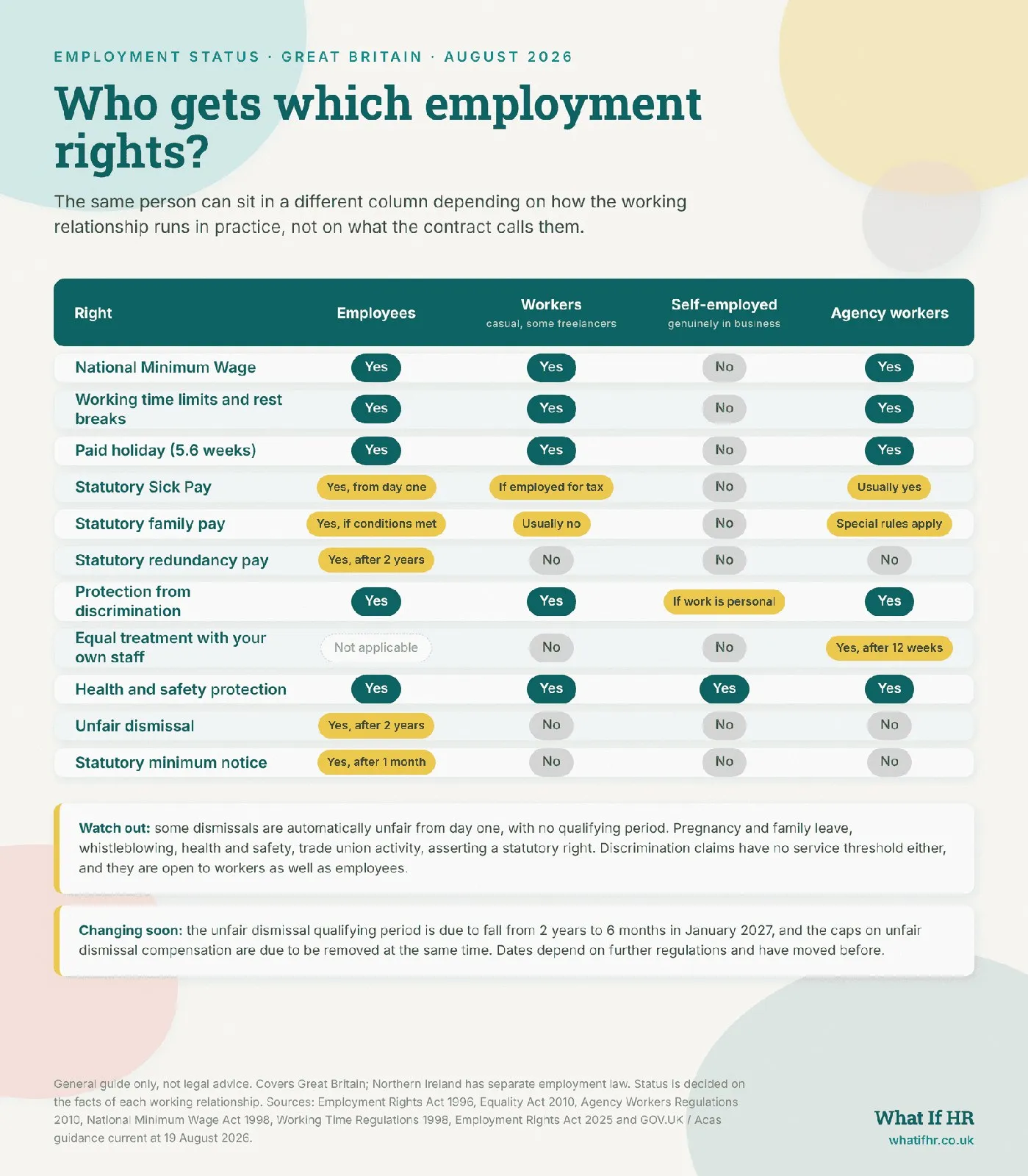
Employment status rights table: who gets what, as at August 2026
Right | Employees | Workers | Self-employed | Agency workers |
|---|---|---|---|---|
National Minimum Wage | Yes | Yes | No | Yes |
Working time limits and rest breaks | Yes | Yes | No | Yes |
Paid holiday (5.6 weeks) | Yes | Yes | No | Yes |
Statutory Sick Pay | Yes, from day one | If employed for tax | No | Usually yes |
Statutory family pay | Yes, if conditions met | Usually no | No | Special rules apply |
Statutory redundancy pay | Yes, after 2 years | No | No | No |
Protection from discrimination | Yes | Yes | If work is personal | Yes |
Equal treatment with your own staff | Not applicable | No | No | Yes, after 12 weeks |
Health and safety protection | Yes | Yes | Yes | Yes |
Unfair dismissal | Yes, after 2 years * | No | No | No |
Statutory minimum notice | Yes, after 1 month | No | No | No |
Sick pay is the one people get wrong. Statutory Sick Pay is not a general "worker" right. It goes to people who are employed for tax purposes, which covers your PAYE staff and most agency workers, but not someone who invoices you and settles their own tax through self assessment. So a freelancer who is legally a worker for holiday pay may still get nothing from you when they are ill. Acas sets out the qualifying conditions here.
Family pay works on a similar test, and agency workers are a special case. Statutory maternity, paternity and adoption pay depend on being treated as an employee for these purposes, plus continuous service and average earnings conditions. GOV.UK notes that agency workers, directors and some education staff have different rules, and where an agency worker does qualify the payment usually comes from the agency rather than from you as the hirer. Do not assume a flat no. Check the individual arrangement.
Discrimination protection reaches further than people expect. The Equality Act 2010 covers employment under "a contract personally to do work", which pulls in workers and some self-employed individuals. The qualifier matters: it applies where the person has to do the work personally, and tribunals have found that some contractors fell outside it. If in doubt, treat everyone who works in your business as protected. It is the right way to run a team and it is the safer assumption.
Health and safety is broad, but it works differently. The Health and Safety at Work etc. Act 1974 puts duties on you towards your employees, and separate duties towards other people affected by your business, which is how a self-employed contractor on your site is covered. That is protection through your duties rather than a personal employment right.
Equal treatment is agency-specific. After 12 weeks in the same role with the same hirer, an agency worker is entitled to the same basic pay, holiday and working time terms as if you had recruited them directly. Your own employees are the comparison point, which is why that cell reads "not applicable" rather than "yes".
The rights that apply from day one, whatever the employment status label
This is where most small businesses carry hidden risk, so it is worth spelling out.
The two-year figure in the unfair dismissal row applies to ordinary unfair dismissal only. Some dismissals are automatically unfair from the first day, with no qualifying period at all: dismissal connected to pregnancy or family leave, whistleblowing, health and safety concerns, trade union membership or activities and asserting a statutory right. Discrimination claims have no service threshold either, and they are open to workers as well as employees.
So "they have been here six weeks, we can let them go without a process" is a risky assumption. You usually have more freedom in the early months, but not unlimited freedom, and the reason for the dismissal matters as much as the length of service.
A few other day-one points worth knowing:
- employees and workers are both entitled to a written statement of employment particulars. The main part is due on the first day, with some further detail within two months
- workers are protected from detriment for making a protected disclosure, from day one
- statutory sick pay became payable from the first qualifying day of absence on 6 April 2026
- paternity leave and unpaid parental leave became day-one rights on 6 April 2026, although the service and earnings conditions for paternity pay did not change. Leave and pay are separate questions and it is easy to answer one and think you have answered both
What has changed: sick pay, holiday and the harassment duty
Sick pay became a day-one payment on 6 April 2026
This is the biggest live change and it hits payroll on every short absence.
Two things went. The three "waiting days", so SSP is payable from the first qualifying day of sickness. And the Lower Earnings Limit, so employees no longer need to earn a minimum weekly amount to qualify. SSP is now paid at the lower of the flat weekly rate or 80% of average weekly earnings, which brings lower-paid staff into scope without paying anyone more than they earn. The flat rate is reset each April, so check the current figure on the Acas SSP page before you run payroll rather than relying on a number in a blog. The changes came in through these commencement regulations under the Employment Rights Act 2025.
In practice: a part-time member of staff who is off for two days now costs you SSP where previously they would have received nothing. If your sickness absence policy still refers to waiting days, it is out of date.
Holiday for irregular-hours and part-year staff is worked out differently
For leave years beginning on or after 1 April 2024, holiday for irregular-hours workers and part-year workers builds up at 12.07% of the hours worked in each pay period. Rolled-up holiday pay is permitted for those two groups, paid as a clearly separate line on the payslip.
This does not change who gets holiday. Employees, workers and agency workers still get 5.6 weeks. It changes how you work it out for casual and seasonal people. Acas explains the definitions and the method here. The definitions are narrower than they sound, so read them before you apply 12.07% to anyone.
The harassment duty is due to get stronger on 30 October 2026
Since 26 October 2024 employers have had a duty to take reasonable steps to prevent sexual harassment of their staff. From 30 October 2026 that is due to become a duty to take "all reasonable steps", with employers also becoming liable for harassment by third parties such as clients, customers and contractors, across the protected characteristics rather than sexual harassment alone. If you have agency staff or contractors on site, they are part of the picture.
What changes in 2026 and 2027, and when
The Employment Rights Act 2025 is being switched on in stages, so much of what you may have read about is passed but not yet in force. As at 1 October 2026, the government's published timeline (last updated 25 September 2026) says:
- 1 October 2026, now in force: the time limit for bringing most employment tribunal claims went from three months to six months, for anything that happens on or after that date. On the same day, from immigration law rather than this Act, right to work checks started to cover workers and individual subcontractors as well as employees.
- 30 October 2026: the "all reasonable steps" harassment duty and third-party harassment liability.
- *January 2027: the qualifying period for ordinary unfair dismissal is due to drop from two years to six months, and the caps on unfair dismissal compensation are due to be removed. Restrictions on dismissal and re-engagement are expected at the same time.
- During 2027: guaranteed hours and shift notice rights for zero-hours and agency staff, day-one bereavement leave, umbrella company regulation, stronger protection for pregnant employees and new mothers, and changes to flexible working.
These dates come from government publications and most of them depend on further regulations. They have moved before, so treat them as planning assumptions and check the timeline again before you build anything around a specific date. Note also that the unfair dismissal change does not extend that right to workers.
The bigger reform, merging employees and workers into a single employment status, has been discussed since 2024. As far as I can see at the time of writing, the consultation on it has not been published, so the four groups above are still how the law works. Worth checking the position before you rely on it either way.
What I would check this month, for those of you with a mixed team
- list everyone who does work for you, including freelancers and agency staff, and write next to each name which of the four groups you think they fall into
- for anyone you have written "self-employed" against, ask whether they can send a substitute, whether they work for other clients, and whether you control how and when they work. If the answers are no, no and yes, look again
- check your sickness absence policy and your payroll settings for the old three waiting days
- check whether any agency worker has passed 12 weeks in the same role, and whether their basic pay and holiday match what a direct hire would get
- if you use casual or seasonal staff, check how their holiday is being calculated and whether rolled-up pay is shown separately on the payslip
- diary a review of your probation and performance processes before the end of 2026, ahead of the January 2027 unfair dismissal change
The point is not to reclassify half your team. Most small businesses find everything sits roughly where they thought it did. The value is in finding the one or two arrangements that have drifted, usually the freelancer who started on two days a month and is now doing four days a week on your systems with your email address.
That is the one worth a proper conversation.
The HR Health Check looks at every contract and arrangement you have and tells you which ones need attention." In the agency worker section, link to Recruitment Support
A note on scope: Great Britain and Northern Ireland
This covers Great Britain. Northern Ireland has separate employment law and much of the above works differently there, although some changes, including the sick pay reform, were extended to Northern Ireland. Check the position separately if you employ people there.
Need one of these written for your business? Contracts, handbooks and single policies are on the HR Documents page, at fixed prices.
This article is general information about UK employment law as at 19 August 2026. It is not legal advice, it does not cover every exception, and the position may have changed since publication. Employment status is decided on the facts of each working relationship, and the future dates above depend on regulations that can change. If you need to know where a specific arrangement in your business stands, speak to an employment solicitor or a qualified HR adviser.
What if one of your "self-employed" people is an employee in law? Worth finding out on your terms. The HR Health Check is where that starts.
What If HR provides practical HR support for small and growing UK businesses without an in-house HR function. If you want a second pair of eyes on your contracts and your worker arrangements, get in touch.