
What if someone's been off sick for weeks?
Someone off sick for weeks: how often to make contact, what to pay after SSP, what the fit note allows, a phased return and when it's a capability matter.


In short
- Keep in touch, and agree how. Acas says the employer and employee should agree how often, by what means and with whom. The contact is about their wellbeing and anything that affects their job. Don't use it to push for a return date.
- Statutory Sick Pay runs for up to 28 weeks, at £123.25 a week (2026/27) or 80% of their average pay if that's lower. If it will run out before they're back, give them form SSP1 by the start of week 23. Holiday keeps building the whole time.
- A fit note is advice. If it says 'may be fit for work' and you can't make the changes, treat it as not fit. A phased return is agreed between you, and SSP can only be paid for full days they don't work.
- Dismissal for long-term sickness is a capability matter and a last resort: up-to-date medical evidence, real consultation, adjustments considered and a written warning that their job is at risk. If the condition could be a disability, get advice before you act.
On this page 12 sections
- How often can I contact an employee who's off sick?
- What does the fit note let me do?
- What if you don't believe they're sick?
- What do I pay someone on long-term sick?
- Can I ask for a medical report or an occupational health assessment?
- What is a phased return to work, and who decides the hours and pay?
- What goes in a return to work interview?
- When does long-term sickness absence become a capability process?
- Is this a disability?
- What if they won't answer at all?
- Quick answers
- Someone off sick now, and no process to follow?
The first fit note said two weeks. The second says four. You've sent a message each week and had two short replies, the rota has a hole in it and you're not sure what you're allowed to ask.
The short answer: long-term sickness absence is manageable if you take it in order. Keeping in touch is allowed, and you should. Agree with them how often and how, and keep it to how they are and anything that affects their job. You pay Statutory Sick Pay (SSP) for up to 28 weeks, £123.25 a week or 80% of their average pay if that's lower, plus any company sick pay your contract promises, and their holiday keeps building. A fit note is advice, and a phased return is something you agree together. Dismissal is possible in the end, on capability grounds, but only after medical evidence, proper consultation and a written warning that their job is at risk. If the condition could count as a disability, get advice before you do anything formal.
The quick version:
- agree the contact: how often, by what means, with whom. Write it down
- keep paying SSP for every qualifying day, and send form SSP1 by the start of week 23 if it will run out before they're back
- read the fit note. "May be fit for work" is advice, and you decide whether you can make the changes
- a phased return gets normal pay for the hours worked. SSP can only cover full days off
- one short return to work conversation, written up the same day
- doubt the sickness? A fit note is evidence you weigh, and dishonesty is a conduct matter. Investigate before you act
- a capability process only once you have medical evidence and have looked at adjustments
Someone off sick now and not sure what to say next?
Book a free 20-minute call and we'll go through where you stand. If it's quick, we'll answer it on the call.
How often can I contact an employee who's off sick?
As often as you've agreed with them. There's no legal number. Acas says the employer and employee should agree how to stay in touch and how much contact is reasonable, and that how often depends on the person's circumstances. So ask. "Would a short message every couple of weeks suit you, or would you rather I rang?" is the whole conversation.
Agree who the contact is with, too. It doesn't have to be the line manager. If the absence is stress-related and the manager is part of it, someone else in the business is better.
What to talk about:
- how they are, and whether anything would help
- anything that affects their job: a reorganisation, a promotion opportunity, redundancies. Acas lists these as updates someone off sick should still get
- when their fit note runs out, and that you'll need the next one to keep paying SSP
What not to do: ask when they'll be back on every call, send work or ring every day. If someone is off with a mental health condition, Acas says to agree the purpose, type and level of contact so it's useful and not overwhelming, and if they find contact too difficult, ask whether a family member or friend could be the point of contact instead.
The first message, if you haven't agreed anything yet, can be this. Change the words in square brackets.
Subject: Checking in
Hi [name],
I hope you're feeling a little better. There's no need to reply straight away.
I wanted to agree how we keep in touch while you're off, so it's useful rather than a nuisance. Would [a short message every two weeks] suit you, and would you rather that's with me or with [name]?
I'll let you know about anything that affects your job while you're away, such as changes in the team. Otherwise I won't be asking about work.
Your fit note runs to [date]. If you're not ready by then, please send the next one when you have it, so your sick pay carries on without a gap.
If there's anything that would help you come back when you're ready, such as different hours for a while, tell me and we'll look at it together.
Take care,
[Your name]
Keep a short note of each contact: the date, how and anything agreed. If this ever becomes a formal process, those notes show you behaved well.
What does the fit note let me do?
It gives you two things: evidence that they're unwell, and advice on what might help them work. What you do with that advice is your decision.
For the first 7 calendar days of a spell of sickness, people self-certify. From day 8 you can ask for a fit note, which a doctor, nurse, occupational therapist, pharmacist or physiotherapist can issue. The note says either "not fit for work" or "may be fit for work", and in the second case ticks one or more of four boxes: a phased return, altered hours, amended duties or workplace adaptations.
Three things from the government's guidance for employers that change how you handle it:
- "May be fit" is advice. You're not obliged to agree to the changes. If you can't make them, you treat the note as if it said "not fit for work", keep paying sick pay on the same note and nobody needs to go back to the GP for a new one
- Nobody is signed back to work. There's no box for it. Someone can come back before the note's end date without seeing anyone first
- A late note doesn't cost them SSP. HMRC's guidance is plain: you can't withhold SSP for late medical evidence, only for days they didn't tell you about in time, and even then not if they had a good reason
The comments box on the note is the useful bit. "Would benefit from reduced hours for two weeks" gives you something to plan around. If it's empty and the absence is heading past a couple of months, that's when a medical report starts to earn its cost (below).
What if you don't believe they're sick?
It happens. Someone rings in with a bad back and a colleague sees them lifting paving slabs at the weekend. Or a fit note lands on your desk covering a fortnight you'd marked down as unauthorised absence. Three rules sort most of it.
For the first 7 days, you can't demand medical evidence as a condition of SSP. The SSP medical evidence rules say so. You can't make them report sickness on a set form, but you can ask them to confirm the absence afterwards in writing, on HMRC's form SC2 or your own, ask about it at the return to work conversation and note anything that doesn't add up.
From day 8, a fit note is evidence, and it's for you to weigh. HMRC's manual puts it plainly: it is up to the employer to consider what evidence of incapacity is acceptable. The government's guidance for employers adds two limits. A note with neither a signature nor the practitioner's name shouldn't be accepted, because it may not be genuine. Most notes now arrive digitally with a name and no signature, and that's fine. And you can't require more medical evidence than a fit note, though you can ask the person to have a further assessment, which in practice means occupational health, with their consent. If you're unsure whether to accept a note, you can ask HMRC for an informal opinion before you decide. They won't make the decision for you.
If you decide not to pay SSP, say why in writing. Give them form SSP1 within 7 days with your reasons. They can ask HMRC's Statutory Payment Disputes Team to decide, and you pay whatever HMRC decides unless you appeal. An employer that refuses or repeatedly fails to pay SSP that is due can be fined up to £3,000. So refuse only when you have something solid, and pay the SSP while you investigate if you're not sure. If it turns out they weren't sick, it's an overpayment of wages and you can recover it.
Not genuine, or exaggerated? Treat it as a conduct matter, and follow your disciplinary procedure. The Employment Appeal Tribunal said in Metroline West v Ajaj (2015) that claiming to be off sick when you're not is dishonesty, and a dismissal for it is a misconduct dismissal, judged on whether you genuinely believed it, on reasonable grounds, after a reasonable investigation. A suspicion is where you start. It isn't a finding. Four steps:
- Investigate before you do anything else. Don't challenge them by text message or in front of the team, and don't ask colleagues to watch them. If a colleague tells you something unprompted, note it and check it
- Collect the evidence for your suspicion, and test it. A photo of someone at a barbecue proves they were at a barbecue. Someone signed off with depression or a back injury isn't expected to stay indoors, and a fit note may say "may be fit" for some work and not for theirs. What counts is evidence of the thing itself: working for someone else, or doing the activity they've said they can't do, more than once. Keep it proportionate: you're processing their personal data, so look only at what bears on the specific allegation, for a set period, and don't go covert (surveillance, trawling their social media) unless you suspect gross misconduct and have no gentler way to check
- Put it to them as an allegation, and let them answer. Invite them in writing to a meeting, setting out what you've found and sending the evidence with the letter, let them bring a colleague or a union representative and listen before you decide anything. There may be an explanation. If there is, it ends there, and you've handled it fairly
- Then follow your normal disciplinary policy, from the decision through to any appeal. The Acas Code applies, because it's conduct, and a tribunal can raise compensation by up to 25% if you ignored it
A fit note that covers days you'd recorded as something else. Fit notes can be backdated: the guidance for healthcare professionals lets them enter an earlier date from which the condition affected the person. So a note that arrives after the event is still evidence, and you consider it like any other. What it doesn't do is rewrite your reporting rule. For SSP, telling you they're sick is separate from proving it: they have to tell you within your time limit, or 7 days if you don't have one, and you don't have to pay SSP for the days they were late telling you, unless they had a good reason, such as being in hospital. You can't withhold it for a late fit note itself. If the days were booked holiday, Acas says someone who falls ill on holiday and reports it in the usual way can take the holiday another time, so what matters is whether they reported it the way your policy asks, as long as that rule is reasonable and you apply it to everyone. Ask them to explain the gap, decide and apply the same answer to the next person who asks.
What do I pay someone on long-term sick?
SSP, from the first full day they'd normally have worked, for up to 28 weeks. Since 6 April 2026 there are no waiting days and no minimum earnings level, so almost everyone you pay through PAYE qualifies. The 2026/27 rate is £123.25 a week or 80% of their average weekly earnings, whichever is lower, split across the days they normally work. Our sick pay post has the sums for part-timers and new starters, and the SSP calculator does them for you.
On top of that, whatever your contract or sickness policy promises. Company sick pay counts towards the SSP due for the same day, so the two aren't added together, and no contract can take SSP away.
The dates that catch people out:
| When | What happens |
|---|---|
| Days 1 to 7 | SSP is payable from the first full qualifying day. They self-certify |
| Day 8 onwards | You can ask for a fit note. SSP carries on |
| Before the start of week 23 | If SSP will run out before they're back, give them form SSP1. They need it to claim Employment and Support Allowance or Universal Credit without a gap. You can send it earlier if it's clear the absence will be long |
| End of week 28 | SSP stops. Their job doesn't. They're still employed, still building holiday and the capability question (below) is yours to manage |
| Any time | Spells of sickness 8 weeks or less apart link together and count as one, so someone off for six weeks in September and again from November is further into their 28 weeks than it looks |
Holiday keeps building the whole time they're off, as normal (Acas). They can ask to take holiday while off sick and be paid holiday pay for it instead of SSP, which matters once SSP has ended or when they're on 80% of low earnings. You can't make them take it. Anyone on long-term sick who can't take their 4 weeks' statutory holiday can carry it over, and has 18 months from the end of the holiday year it came from to use it (Working Time Regulations 1998, regulation 13). Your contract decides what happens to the extra 1.6 weeks and anything above that.
One more date trap. If it does end in dismissal, someone off sick during their statutory notice period is often entitled to full pay for that notice, not SSP, unless the notice you have to give them under the contract is at least a week longer than the legal minimum (Employment Rights Act 1996, sections 87 and 88). Check before you work out a final payslip.
Can I ask for a medical report or an occupational health assessment?
Yes, with their consent, and it's usually the step that unsticks everything. A fit note tells you they're unwell. A report tells you what's likely to happen next and what would help, which is what you need before you decide anything.
There are two routes:
- A report from their own GP or consultant. This comes under the Access to Medical Reports Act 1988. You need their written consent and you must tell them their rights in writing. They can ask to see the report before it reaches you, ask for corrections or withhold it altogether. If they ask to see it first, the doctor has to wait up to 21 days for them to arrange that. Acas sets out the steps
- An occupational health assessment. An independent occupational health provider looks at the job and the person and reports on fitness for it, adjustments and a likely timescale. For a small business this is a one-off fee for a single assessment. You don't need a contract with a provider. The 1988 Act's formal rights don't apply where the practitioner has never treated them, but you still need their consent to the assessment and to the report being released. Once you have the report, it's health data: keeping it is part of your duties as an employer and belongs in your privacy notice, not on a consent form, so store it apart from the general file and share it only with whoever needs it
Check the contract first. Many employment contracts say the employee agrees to attend a medical examination by a doctor or occupational health adviser the employer chooses, and to let the report be shared with the employer. If yours does, and the request is a reasonable one (a long absence with no clear end is the usual case), you can instruct them to attend, and a refusal without a good reason is a failure to follow a reasonable instruction, which you can deal with under your disciplinary procedure. Realistically that means a warning. Dismissing someone for the refusal alone would be hard to defend, and the refusal matters more as a fact: you asked, they said no, and you decided on what you had. Two things stay the same whatever the contract says. Nobody can be examined against their will, and the occupational health adviser will still ask them to agree to the report being released, so if they refuse either, you decide on what you have. And for a report from their own GP or consultant, the Access to Medical Reports Act rights apply at the time you ask: the clause doesn't replace the written consent and the notice of their rights, and they can still see the report first or withhold it. If your contract is silent, you can only ask. Either way, add the clause to your contract template for next time.
You pay for either. If they refuse, Acas says you make decisions on what you have: what they've told you, the fit notes and any earlier report. Say that to them, kindly and in writing, before they decide.
Ask specific questions: what they can do now, what they can't, when a return is likely, what would help and whether the condition is likely to last 12 months or more. "Is she fit for work?" gets you a one-line answer and another month of not knowing.
What is a phased return to work, and who decides the hours and pay?
A phased return is coming back gradually: fewer hours, different duties or a lighter load for a few weeks, then building up. Acas says how long it lasts depends on the person. The fit note often suggests a length, and the employer and worker should agree it together and review it as it goes.
Pay follows two rules:
- For hours worked, normal pay. If they come back to their usual job on reduced hours, they get their usual rate for those hours. If they're doing lighter work, you agree a rate and put it in writing
- For the hours not worked, whatever applies: full pay if your policy or the agreement says so, company sick pay if you have it or SSP if they're eligible and still within their 28 weeks. SSP can only be paid for full non-working days, never for part of a day
A worked example. Someone who normally works five days comes back for three, Monday to Wednesday, for four weeks. You pay three days at their normal rate. If they'd normally have worked Thursday and Friday and they're still unwell on those days, SSP can be paid for those two days at the daily rate: on the full rate, £123.25 divided by five qualifying days is £24.65 a day, so £49.30 for the week, as long as their 28 weeks haven't run out. HMRC's Statutory Payments Manual is clear that the days they work can't be treated as days of incapacity.
Whatever you agree, write it in one short letter: the hours, the duties, the pay for the hours worked and for the rest, the review dates and the date it ends. Review it when you said you would. If it needs another two weeks, give it another two weeks.
What goes in a return to work interview?
Fifteen minutes, the day they come back or the day before, in private. Acas calls it a return to work meeting. It's not a legal requirement, and Acas describes it as often just an informal chat between the worker and their manager. Done well it's the single most useful thing in this post, because it's where you find out what would stop the next absence.
Cover five things:
- Are they ready? What they can do now, what they can't yet, anything the fit note or report recommends
- What they missed: changes in the team, new customers, anything that affects their role
- Support: a phased return, changes to hours or duties, equipment, time off for appointments
- The plan: what starts when, and when you'll review it
- Confidentiality: what colleagues have been told, and what the person wants kept private
They don't have to tell you anything about their health. Most people will tell you plenty if you're not holding a form between you. Write it up the same day, as if they'll read it. They can ask to.
Our return to work interview form puts those five things on one page, with the manager's checks down the side. It's free, with no email to give. Print it, or type into it on screen:
Download the return to work interview form (PDF)
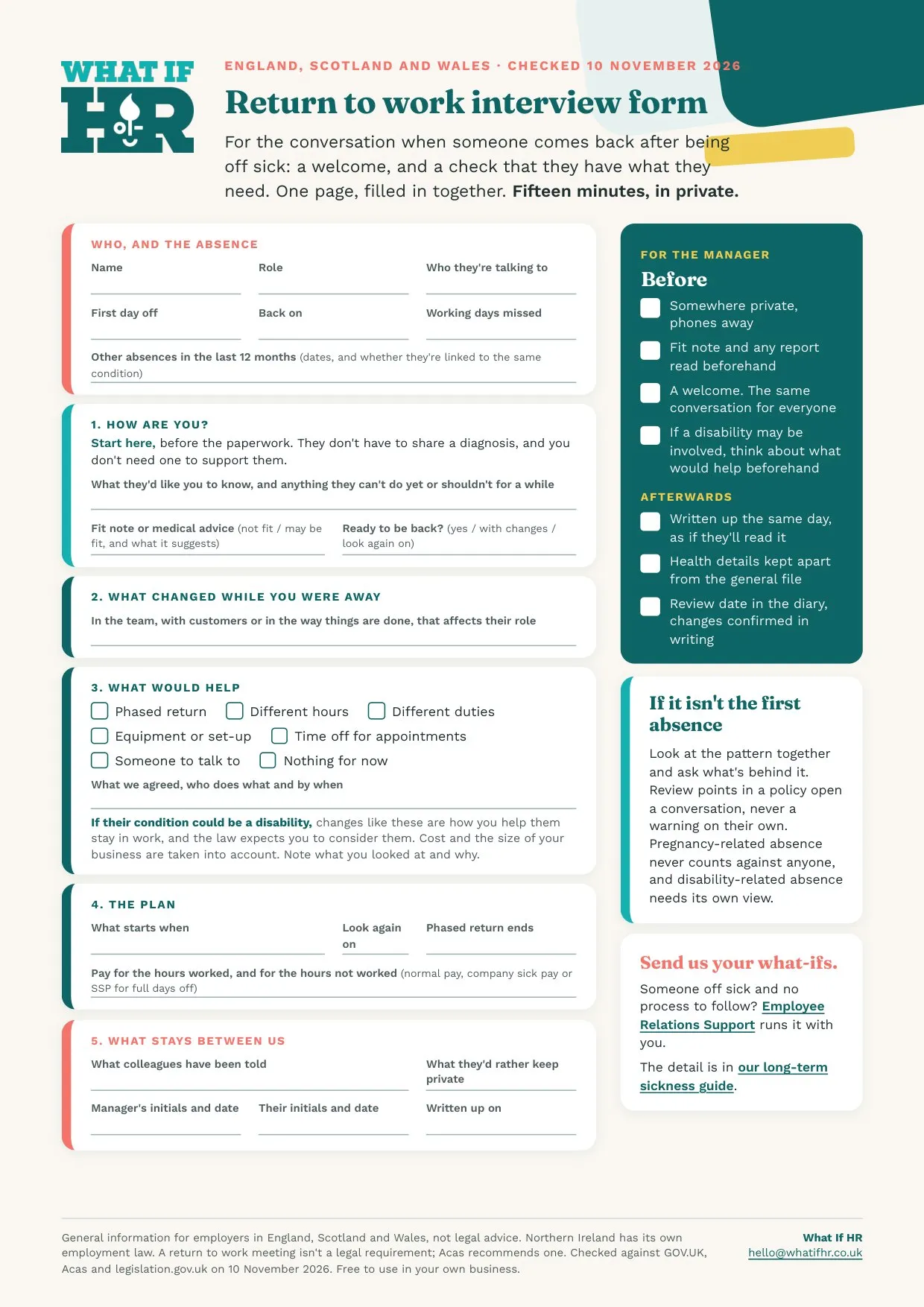
The form, on one page. Download the PDF to print, or to fill in on screen.
When does long-term sickness absence become a capability process?
When the evidence says a return isn't likely in a time the business can reasonably hold the job open, and not before. Acas puts it simply: dismissal because of long-term illness would usually be a capability issue, and dismissal should be a last resort after you've supported the person and tried to help them back.
Capability is one of the fair reasons for dismissal in section 98 of the Employment Rights Act 1996. What makes it fair in practice is the process. In a team of eight, that looks like this:
- Get the medical picture up to date. A report or occupational health assessment, with a prognosis and the question "what would help?" answered. A six-month-old fit note is not a basis for a decision
- Meet them. Invite them in writing, say what the meeting is for, let them bring a colleague or a union representative and hold it somewhere that works for them, including by phone or video if they're not well enough to come in. Listen to their view of when they'll be back and what would help
- Look hard at the alternatives. A phased return, different hours, different duties, another role if one exists, more time. Write down each one and why it does or doesn't work. "We're too small to cover it" can be a real reason, but you need to show you looked
- Warn them, in writing. That if a return isn't possible by a stated date, you'll have to consider ending their employment on capability grounds. Give a real chance to respond
- Decide, and give proper notice. Confirm the reasons in writing and offer an appeal, heard by someone who wasn't involved if you have anyone
The Acas Code of Practice on disciplinary procedures is written for conduct and performance, so it doesn't apply to a genuine ill-health dismissal and there's no 25% uplift for not following it. Tribunals still expect the steps above. If the person has worked for you for two years, they can claim unfair dismissal now. From 1 January 2027 that falls to six months' service, and the cap on compensation goes (our probation post has the dates). Discrimination protection applies from day one regardless, which is where the next question comes in.
At any of these steps, if you're not sure, stop and ask. This is exactly what Employee Relations Support is for: we run the process with you, draft the letters and sit in the meetings.
Is this a disability?
Possibly, and you may not know. Under the Equality Act 2010, a disability is a physical or mental impairment with a substantial, long-term effect on day-to-day activities, where long-term means it has lasted or is likely to last 12 months or more. Depression, anxiety, long Covid, cancer, diabetes, a back condition: any of these can count. Cancer, HIV and multiple sclerosis count from diagnosis.
If it does, two duties follow:
- Reasonable adjustments. You must consider changes that remove or reduce the disadvantage: a phased return, different hours, redistributing some duties, equipment, time off for treatment. "Reasonable" takes account of cost, what's practical and the size of your business, so a small employer isn't expected to do what a large one can (Acas). Access to Work can fund some support, but it doesn't replace your duty or pay for it
- Not treating them unfavourably because of something arising from the disability, such as the absence itself, unless you can justify it as a proportionate way of achieving a legitimate aim (section 15). A dismissal for absence that flows from a disability has to clear that bar as well as the capability process above
The duty bites when you know, or could reasonably be expected to know, about the disability. A long absence with a fit note mentioning anxiety is enough to start asking the question, which is another reason to get the medical report.
A case from October 2026 shows where the risk sits in practice. In McManus v British Airways, a cabin crew member with depression and anxiety was preparing to return after a long absence. In an occupational health call she mentioned Access to Work, and the practitioner told her the scheme was for "people in wheelchairs". The tribunal found the remark unwanted and related to her disability, but in the context of a medical consultation not reasonable to treat as harassment, and the Employment Appeal Tribunal agreed on 9 October 2026. The employer won. But the case ran for more than four years from that phone call, and it started with one careless sentence in a welfare conversation. The EAT also said her mental health was relevant to how the remark should be judged, though not decisive. So when you know someone has anxiety or depression, plan the sensitive conversations with extra care, and keep a note of what was asked and why. The harassment duties that started on 30 October 2026 cover sexual harassment and, where the person making the remark is a third party such as an outside occupational health provider, harassment related to disability too. The habits are the same either way.
What if they won't answer at all?
Don't assume anything, and put everything in writing.
- Send the message above, by whatever means you've used before. Give it a week
- Then a letter to their home address. Say you're concerned, that you'd like to agree how to keep in touch and that you'd like them to contact you by a date. Remind them that SSP continues as long as fit notes are provided, and that you don't have to pay for days you haven't been told about. Offer a different contact, including someone from their family if they'd prefer. Keep it warm. They may be reading it on a bad day
- If there's still nothing after a reasonable time, invite them in writing to a meeting (by phone or video if that's easier, with a companion if they want one) and say that without contact you'll have to make decisions on the information you have. That's where the capability process above begins, with every step still to follow
What not to do: treat silence as a resignation, stop pay that's due or turn up at their house. If you think they may be at risk, ring their emergency contact. That comes before any HR process.
Quick answers
How long can an employee be off sick for?
There's no legal limit. Statutory Sick Pay stops after 28 weeks, but their employment continues until one of you ends it. Ending it for long-term absence is a capability dismissal, which needs medical evidence, consultation, a look at adjustments and a written warning that their job is at risk.
Can I contact an employee who is off sick?
Yes. Acas says the employer and employee should agree how often, by what means and with whom. Keep it to how they are, anything that affects their job and the dates of their fit notes. Don't pressure them about a return date.
Do I have to pay someone on long-term sick leave?
SSP for every qualifying day for up to 28 weeks, at £123.25 a week (2026/27) or 80% of their average weekly earnings if that's lower, plus any company sick pay your contract promises. If SSP will run out before they're back, give them form SSP1 by the start of week 23.
Does holiday build up while someone is off sick?
Yes, as normal. They can ask to take holiday while off sick and be paid holiday pay for it, and you can't force them to. Up to 4 weeks' statutory holiday they couldn't take carries over, to be used within 18 months of the end of the holiday year it came from.
Can I ask for a doctor's report?
Yes, with the employee's written consent. For a report from their own GP or consultant, the Access to Medical Reports Act 1988 gives them the right to see it first, ask for corrections or withhold it. An occupational health assessment from an independent provider still needs their agreement. If their contract says they'll attend a medical examination and let the report be shared, you can instruct them to attend, though the Act's rights still apply to a report from their own doctor. You pay for either.
Do I have to agree to a phased return?
A fit note that suggests one is advice. If you can't make it work you treat the note as "not fit for work". But if the person is disabled, a phased return is often a reasonable adjustment, and refusing one without a good reason is a risk. Agree the length, the duties and the pay in writing.
Is long-term sickness a disability?
Not automatically. It's a disability if the condition has a substantial, long-term effect on day-to-day activities, where long-term means 12 months or more, or likely to be. Many conditions behind a long absence meet that test, so ask the question early and get medical advice.
Can I dismiss someone on long-term sick?
Eventually, yes, on capability grounds, if the medical evidence says a return isn't likely within a time you can reasonably hold the job open and you've followed a fair process. Anyone with two years' service can claim unfair dismissal now, and from 1 January 2027 that falls to six months. If the condition could be a disability, get advice first.
Do I have to accept a fit note I don't believe?
A fit note is evidence, and it's for you to weigh. You can't ask for more medical evidence than a fit note as a condition of SSP, but you can ask for an occupational health assessment with the person's consent, and you can ask HMRC for advice. If you refuse SSP, give written reasons on form SSP1 within 7 days, and the employee can ask HMRC to decide. If you think the sickness isn't genuine, that's a conduct matter: investigate, collect the evidence, put it to them as an allegation and let them answer, then follow your disciplinary procedure.
What if a fit note arrives for days we recorded as holiday or unauthorised absence?
Fit notes can be backdated, so it's still evidence and you consider it. But telling you is separate from proving it. You don't have to pay SSP for the days they were late in telling you, unless they had a good reason, and you can't withhold it because the note itself arrived late. For booked holiday, it depends whether they reported the sickness the way your policy asks, as long as that rule is reasonable and applied to everyone. Ask them to explain the gap and apply the same rule to everyone.
Can I take on someone to cover while they're off?
Yes. A fixed-term contract or agency cover for the absence is normal. Their job stays theirs until their employment ends, so make it clear in the cover's contract that it's for the absence.
Someone off sick now, and no process to follow?
Most long-term absences in small businesses go wrong in the same two places: nobody agreed how to keep in touch, so the silence grew, and nobody asked for a medical report, so a decision got made on a hunch. Both are fixable this week.
If you're in the middle of one, Employee Relations Support gives you someone who has done this before: the letters, the meetings and the judgement calls, from the first conversation to the outcome. If you have two or three managers each handling sickness their own way, a Retained HR Partner gives them one person to ask, and we'll put a short absence management policy in place that everyone follows. If you run a care service, where sickness cover is a daily problem, see our HR support for care providers. Every service and price is on one page: HR support for small businesses.
What if the hardest part of this is the first phone call?
Send us your what-ifs.
This is general information for employers in England, Scotland and Wales, not legal advice. Northern Ireland has its own employment law. If you're dealing with a specific situation, speak to an employment solicitor. Checked against GOV.UK, HMRC, Acas and legislation.gov.uk on 10 November 2026.