
What if your best employee hands in their notice?
Your best person resigns. What to say in the first 48 hours, whether to counter-offer and how to keep good people when you can't pay more.


In short
- When a key person resigns, make no offer in the first conversation. Thank them, ask why and agree to talk again within 48 hours.
- A counter-offer that only adds money rarely fixes the reason they started looking. If the reason is something you can change, say what and from when, in writing.
- A stay conversation with your best people, once or twice a year, tells you what keeps them before anyone is on the way out.
- Any employee can ask for flexible working from day one. You have two months to decide, must talk to them before you say no and can refuse only for one of eight business reasons. From October 2027 the refusal will also have to be reasonable.
On this page 8 sections
Have you got one person the business would wobble without? The one clients ask for by name, who you have never once had to chase?
What if they knocked on your door tomorrow with a letter?
The short answer: don't counter-offer in the first conversation. Thank them, ask why and agree to talk again within 48 hours, then decide whether the reason is something you can and want to fix. The better time to act is earlier, with a regular conversation about what keeps your best people and a ready answer when they ask for something other than money.
What do you say when they resign?
Less than you want to. The first reaction is usually panic, sometimes hurt ("after everything we've done for them"), and both come out as a speech or a number. So in that first conversation:
- thank them for telling you in person
- ask what is behind it, and listen. "Can I ask what made you start looking?" is enough
- don't argue, guilt-trip or name a figure
- agree when you will talk again, ideally within 48 hours
If what they tell you sounds like a complaint about how they have been treated, take it seriously and get advice before you reply.
Should you make a counter-offer?
Sometimes. It depends on why they are going.
Ask yourself one question: if they had asked for this six months ago, would I have said yes? If the answer is yes and their pay has fallen behind what the job pays elsewhere, a fair rise now is reasonable. Put what changes, and from when, in writing.
If the answer is no, a rise given under pressure teaches the rest of the team that resigning is how you get one. And if the reason is the workload, the manager or no sign of a future, money buys you a few months. The reason they started looking is still there.
Say your office manager of four years is leaving for the same pay and a shorter commute. Matching the salary changes nothing. Offering two days at home might.
The first 48 hours: a checklist
| When | What to do |
|---|---|
| In the meeting | Thank them, ask why and agree a time to talk again. No offers yet |
| Straight after | Check the notice in their contract. The legal minimum from an employee is one week once they have worked for you for a month (Acas) |
| Within 48 hours | The second conversation: would anything change their mind, and can you offer it? Then confirm the outcome and the last day in writing |
| Before anyone else hears | Agree with them what the team and clients are told, and who tells them |
| During the notice | A handover list: open work, logins, client contacts and who picks up what |
| Before the last payday | Work out final pay, including holiday built up and not taken (Acas on final pay) |
If they are going to a competitor and you would rather they stayed at home for the notice (garden leave), check the contract first. If it has a garden leave clause, you can use it. If it doesn't, ask them to agree. Either way they are still employed and get their usual pay and benefits (Acas).
What is a stay conversation?
An exit interview, held while the person still works for you. Twenty minutes, once or twice a year, with each person you would hate to lose. Five questions are plenty:
- what do you look forward to at work?
- what would you change if you ran the place for a week?
- what would tempt you to leave?
- where do you want to be in two years, and can you see a way to get there here?
- what do I do that makes your job harder?
Write down what they say, then do one thing from it within a month. If you can't do what they asked, tell them why.
The thought that stops most owners: "If I ask what would make them leave, I'll put the idea in their head." If they are unhappy, the idea is there already. This way you hear it first.
What can you offer when you can't pay more?
Pay matters. If someone earns well below what the same job pays down the road, nothing here will make up for it for long. But it is rarely the only thing you can change.
- flexibility. When, where and how much people work. In CIPD research from May 2023, 6% of employees said they had left a job in the past year specifically because of a lack of flexible working. When owners say no, it is usually because it looks hard to run, before anyone has tried it. Try it for three months
- growth. A new skill, a course or a client of their own. It doesn't have to be a promotion
- recognition. A specific thank you, said at the time. "The way you handled that complaint kept the client" lands. "Great job, everyone" doesn't
- a clear role. Knowing what they are responsible for, what good looks like and who decides what. Good people tire of guessing
An anonymous survey will tell you which of these matters most to your team. It is part of our Culture and Engagement work.
What does the law say about flexible working requests?
As at 7 November 2026, in England, Scotland and Wales:
- any employee can make a statutory request from their first day in the job, a right that started on 6 April 2024 (Acas Code of Practice)
- they can make two requests in any 12 months
- you must decide, including any appeal, within two months, unless you both agree to longer (Acas)
- you must talk to them before you refuse
- you can refuse only for one of eight business reasons (GOV.UK): extra costs that will damage the business, the work can't be reorganised among other staff, you can't recruit people to do it, it will affect quality, it will affect performance, you won't be able to meet customer demand, there isn't enough work at the times they want or you are planning changes to the workforce
The Employment Rights Act 2025 tightens this. The eight reasons stay, but a refusal will also have to be reasonable, and you will have to explain why you think it is. The government timeline, last updated on 5 November 2026, puts flexible working in October 2027 and says dates can still change. Every stage is on our employment law changes page.
Our advice: answer every request as if that test applied now, and where a no would be hard to explain, offer a trial.
Also, someone who asks for flexible working must not be treated worse for asking (Employment Rights Act 1996, section 47E). That protection applies from day one, including during probation.
When is it time to let them go?
When what they need doesn't exist in your business: the bigger role isn't there at eight people, or the salary their skills now command is beyond you. Then let them go well:
- tell them you are sorry to lose them, and mean it
- agree a handover that fits the notice they are giving
- ask for a short exit conversation and note what you learn
Our exit interview template has two pages. The first is for the person leaving: it tells them what the conversation is for, what happens to what they say and the questions in advance, and lets them choose who they talk to and how. The second is for your notes: a way to open, what pulled them and what pushed them, their answers and what you'll change. It's free, with no email to give. Print it, or type into it on screen:
Download the exit interview template (PDF)
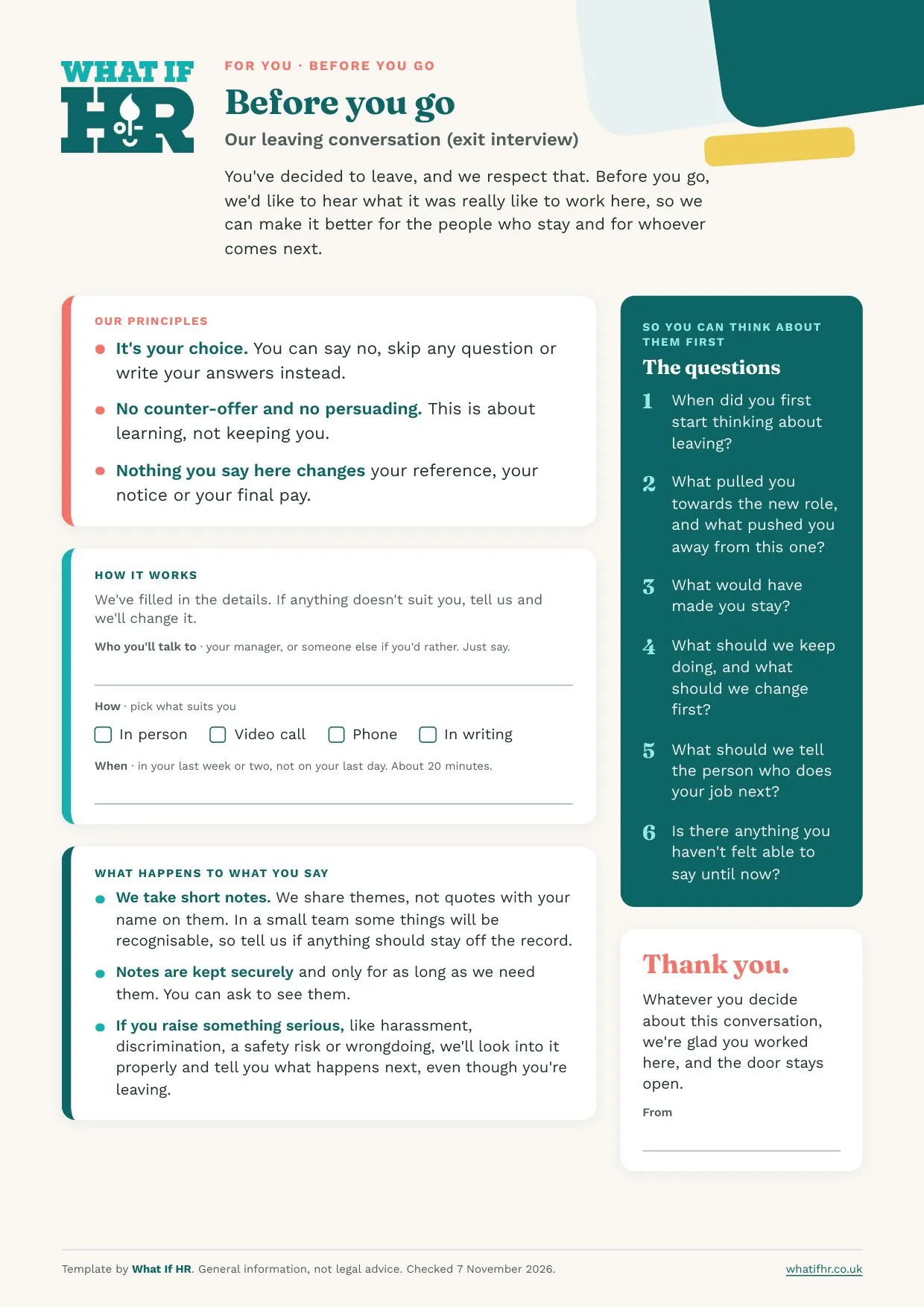
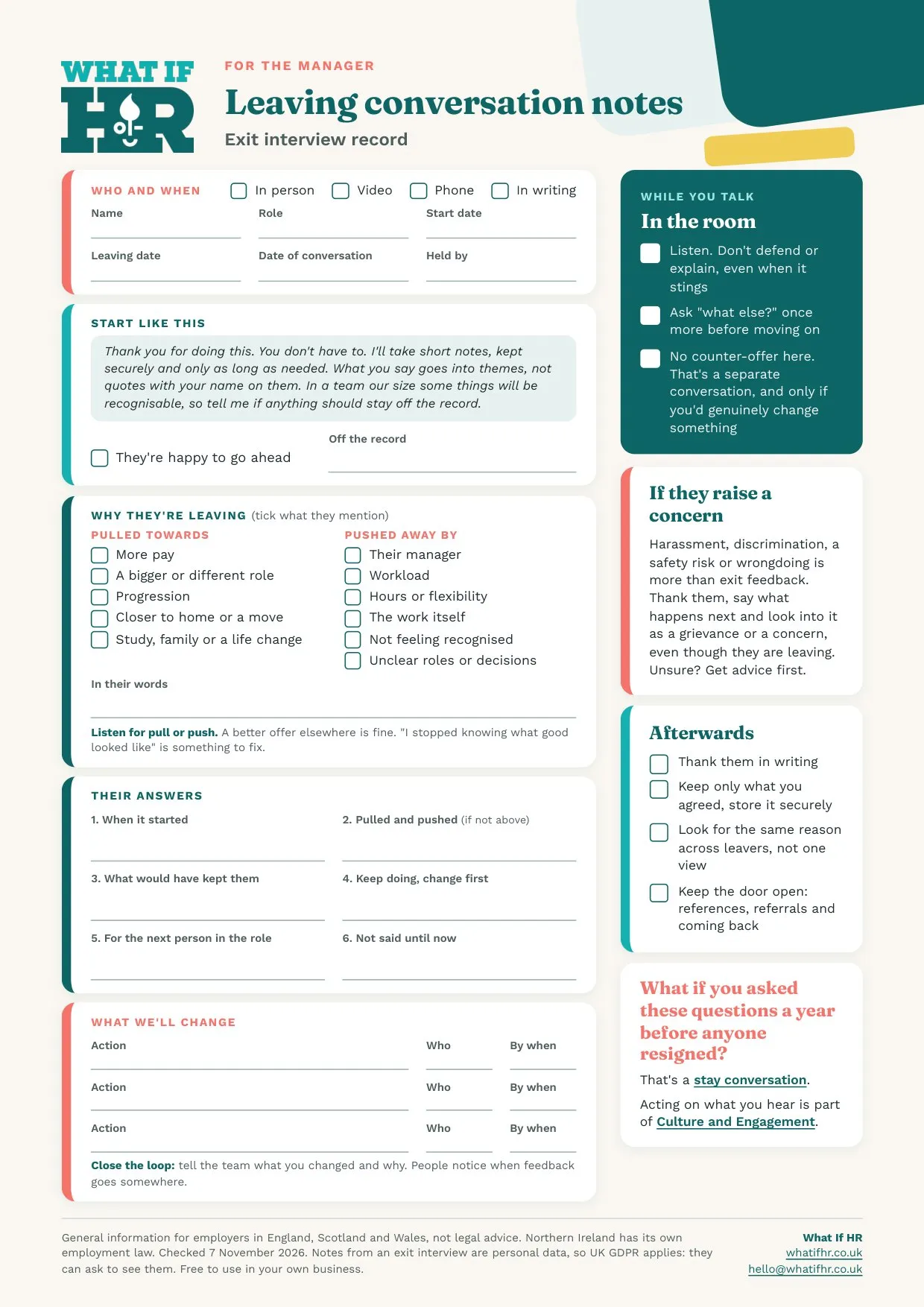
The template, on two pages. Download the PDF to print, or to fill in on screen.
In most cases you don't have to give a reference by law, unless you agreed in writing that you would (Acas). If you give one, keep it to facts. People remember how you behaved when they left.
Frequently asked questions
Can I refuse to accept a resignation?
No. Once someone has clearly resigned, the notice runs. You can ask them to reconsider, and if you both agree they will stay, confirm it in writing. If they said it in the heat of the moment, give them a day or two to confirm before you treat it as final.
How much notice does an employee have to give?
What their contract says, and at least one week once they have worked for you for a month. You can agree a shorter notice between you, in writing.
Can I say no to a flexible working request?
Yes, for one of eight business reasons, after talking to the employee and within two months, including any appeal. From October 2027 the refusal will also have to be reasonable.
What is the difference between a stay conversation and an appraisal?
An appraisal looks at how the person is doing. A stay conversation looks at how the job is doing for them. Keep them in separate meetings, so the person can speak freely.
What if the person you would hate to lose just needs to be asked?
If someone has just resigned and you want a second opinion before the next conversation, or you would like stay conversations to happen without having to remember them, that is what our Retained HR Partner clients use us for. To see where things stand first, there is the HR Health Check. Or book a free 20-minute call.
Send us your what-ifs.
This is general information, not legal advice. If you're dealing with a specific situation, speak to an employment solicitor. Checked against GOV.UK, Acas, legislation.gov.uk and the CIPD on 7 November 2026.
Free downloads