
Guest post
How to make training work in a small business
Most training fails after the course, not during it. Occupational psychologist Anna Wheeldon on what makes staff training stick in a small business.

Guest post by Anna Wheeldon, Consultant Partner, Leadership & Training

In short
- Training rarely fails in the room. It fails before, when nobody defined what should change, and after, when people get no chance to use what they learnt.
- Start with the end goal: who will be able to do what, by when, and how you will know.
- Managers decide whether learning sticks: time to attend, time to practise and follow-up in one-to-ones.
- Short sessions spaced over weeks, with more practice than listening, beat a full-day workshop. Judge the result by what changes at work, not by the feedback form.
On this page 14 sections
- What is learning transfer?
- Every organisation needs training
- Training is often a business requirement
- Start with the end goal
- The most overlooked factor: management support
- Stop thinking in full-day workshops
- People need to practise more than they listen
- Learning styles: the popular myth
- The real work happens after training
- What helps learning transfer?
- How do you measure whether training worked?
- Final thought
- Quick answers
- References
If you're a business owner, chances are you've spent money on training and wondered whether it was worth it. People attended, certificates were issued, everyone seemed positive on the day, and then a few weeks later nothing really changed.
The truth is that training itself rarely creates results. What creates results is what happens before, during, and most importantly after the training.
The short answer: training works when you plan what happens before and after the session, not just the session itself. Define the change you need, get managers behind it, keep sessions short and spaced, build in practice, reinforce it at work and measure what changes.
What is learning transfer?
What is learning? Learning is a "relatively permanent change in behaviour that occurs as a result of practice or experience". Learning transfer is putting that learning into action: if there is a high level of transfer the training has been successful and if nothing really changes then there has been a low level of transfer.
Research into learning transfer and workplace performance has consistently found that the strongest training programmes follow a similar pattern:
- Needs analysis
- Manager buy-in
- Short, spaced learning sessions
- Deliberate practice
- Immediate workplace application
- Reinforcement and coaching
- Behaviour and business impact measurement
The good news is that this process is entirely achievable for small businesses. In fact, smaller organisations are often better placed to make training successful because they can move more quickly and create stronger connections between learning and day-to-day work.
Every organisation needs training
One misconception I still encounter is that training is something you do for junior employees.
Not true.
Every business needs to train its people, including and especially the owners and senior leadership team. Being experienced does not mean you know everything. If anything, the more senior you become, the more important it is to keep learning.
Let's think about the things that change:
- markets
- technology
- employee expectations
- customer expectations
- legislation
As we know, AI is changing almost every sector at a rapid pace so standing still is often the greatest risk.
The best leaders are not those who know everything already. They are the ones who remain curious enough to keep learning.
Training also matters for recruitment and retention. High-quality candidates increasingly want to know how an organisation will help them grow. They want opportunities to develop their skills, expand their expertise and prepare for greater responsibility. If your answer to "How will I develop here?" is vague, you may struggle to attract the people you need.
Training is often a business requirement
Many organisations invest in training because they have a problem to solve.
Perhaps you are:
- implementing a new system
- expanding into new markets
- employing apprentices
- introducing AI tools
- developing managers
- improving customer service
- reducing errors
- creating a more productive culture
- meeting legal and regulatory obligations
When it comes to compliance, organisations need to be particularly careful. A five-minute conversation about preventing sexual harassment, equality or health and safety is unlikely to provide the depth of understanding your team needs. Effective compliance learning requires engagement, practice, discussion and reinforcement. It should support a wider culture rather than simply serve as a tick-box exercise.
Whatever the motivation, the real question is not whether training should happen.
The question is:
How do you ensure that training delivers a genuine return on investment?
Start with the end goal
The most important stage of any learning intervention happens before anyone enters a training room. You need clarity on what the training is supposed to achieve. I regularly hear statements such as:
"We need to develop our leaders."
But what does that actually mean? Develop them from what? What are they currently doing that needs to change? Which behaviours need improving? Which skills need strengthening? How will you know when development has happened?
Without clear answers, it becomes very difficult to select the right learning solution. By contrast, consider this objective:
"We need everyone to be able to confidently use our new booking system by 1st May, take customer bookings accurately and handle common customer queries."
The objective and desired behaviour is clear and success can be managed.
This process is often referred to as a Training Needs Analysis (TNA), and research consistently shows that the more precisely a learning need is defined, the more effective the resulting intervention is likely to be.
The most overlooked factor: management support
One of the strongest predictors of training success is not the quality of the trainer, it's the quality of support from managers.
Research on training transfer repeatedly finds that colleagues are significantly more likely to apply learning when their managers actively encourage, reinforce and support new behaviours.
Before commissioning any training, ask yourself:
- Does the senior leadership team believe this matters?
- Is there a visible sponsor?
- Will team members be given time to attend?
- Will they be given time to practise afterwards?
- Will managers discuss learning in one-to-ones?
- Will progress be reviewed and recognised?
If the answer to these questions is no, the chances of sustained behaviour change or new ways of working are dramatically reduced.
Too many organisations invest in learning while simultaneously creating barriers that prevent people from using it.
Stop thinking in full-day workshops
Many organisations still default to long training days, but the evidence increasingly points in another direction. Research on spaced learning demonstrates that shorter learning sessions delivered over time are generally more effective than large amounts of learning delivered in a single event. This is because learning requires processing, reflection and practice. A full-day workshop may feel productive, but information overload often leads to poor retention.
Instead, consider:
- multiple shorter sessions over several weeks
- activities between sessions
- reflection exercises
- workplace assignments
- follow-up discussions
We need to start to see learning as a process, not an event.
People need to practise more than they listen
One of the biggest mistakes in workplace training is talking too much. People do not become skilled because they have heard information. They become skilled because they have practised using information.
This principle is supported by research on deliberate practice, particularly the work of psychologist Anders Ericsson. Expertise develops through focused practice, feedback and repeated improvement rather than passive exposure to knowledge.
Effective training therefore includes:
- role plays
- simulations
- case studies
- on-the-job projects
- peer coaching
- realistic workplace scenarios
Participants should spend considerably more time doing than listening. If someone can explain a concept but cannot apply it in a real-world situation, the training has not yet achieved its purpose.
Learning styles: the popular myth
At this point, someone will inevitably ask:
"What about learning styles?"
The idea that individuals are visual, auditory or kinaesthetic learners remains extremely popular. However, the research evidence does not support designing training around preferred learning styles.
A highly cited review by Pashler and colleagues (2008) found no convincing evidence that matching instructional methods to an individual's preferred learning style improves learning outcomes.
What matters far more is matching the method to the skill being taught.
For example:
- Demonstrations work well for practical tasks.
- Discussion works well for complex problem-solving.
- Simulations work well for decision-making.
- Practice and feedback work well for behavioural change.
The better question is not: "What learning styles do our employees have?"
It is: "What learning methods best support the capability we are trying to develop?"
The real work happens after training
Perhaps the most important finding from the training literature is that post-training activities are just as important as the training itself.
Many organisations invest heavily in delivery and almost nothing in reinforcement. For learning to transfer into workplace behaviour, people need opportunities to use their new skills quickly and repeatedly.
Effective reinforcement can include:
- thirty-day check-ins
- coaching conversations
- peer discussions
- refresher modules
- action learning groups
- knowledge quizzes
- practical workplace assignments
The sooner learning is applied in real work situations, the more likely it is to stick.
What helps learning transfer?
Research identifies several factors that increase the likelihood of training success:
Positive factors
- motivation to learn
- confidence and self-efficacy
- practical training design
- supportive managers
- encouraging colleagues
- opportunities to practise
- feedback and coaching
- recognition and reward
Self-efficacy deserves particular attention. This refers to an individual's belief in their ability to perform a task successfully. Colleagues who believe they can use a new skill are more likely to try, persist and improve. Building confidence is therefore not a "nice to have". It is a significant contributor to learning transfer.
Barriers to success
Training often fails because of organisational factors rather than poor content and these areas should be assessed before allocating time and money to training.
Common barriers include:
- work overload
- lack of manager support
- bureaucratic processes
- fear of change
- lack of resources or equipment
- negative peer pressure
- organisational inertia
- scepticism about change
If these barriers remain unaddressed, even excellent training can struggle to create lasting impact.
How do you measure whether training worked?
Ultimately, training should not be judged by attendance rates or feedback forms. A "happy sheet" at the end of a workshop is a poor indicator of training success, rather it is a reflection on how much someone enjoyed their training. Training effectiveness should be judged by outcomes.
Ask:
- What behaviours have changed?
- What skills have improved?
- What business results have been achieved?
- What problems have been solved?
If leadership capability was the goal, are managers now having better conversations? If customer service was the focus, are customer scores improving? If a new system was introduced, are colleagues using it accurately and confidently?
Training only becomes valuable when learning translates into performance.
Free download: the training plan on a page puts these steps on one page, from the end goal to the 30-day check-in and the measures. No email needed. Type into it on screen and keep one for each piece of training.
Download the training plan on a page (PDF)
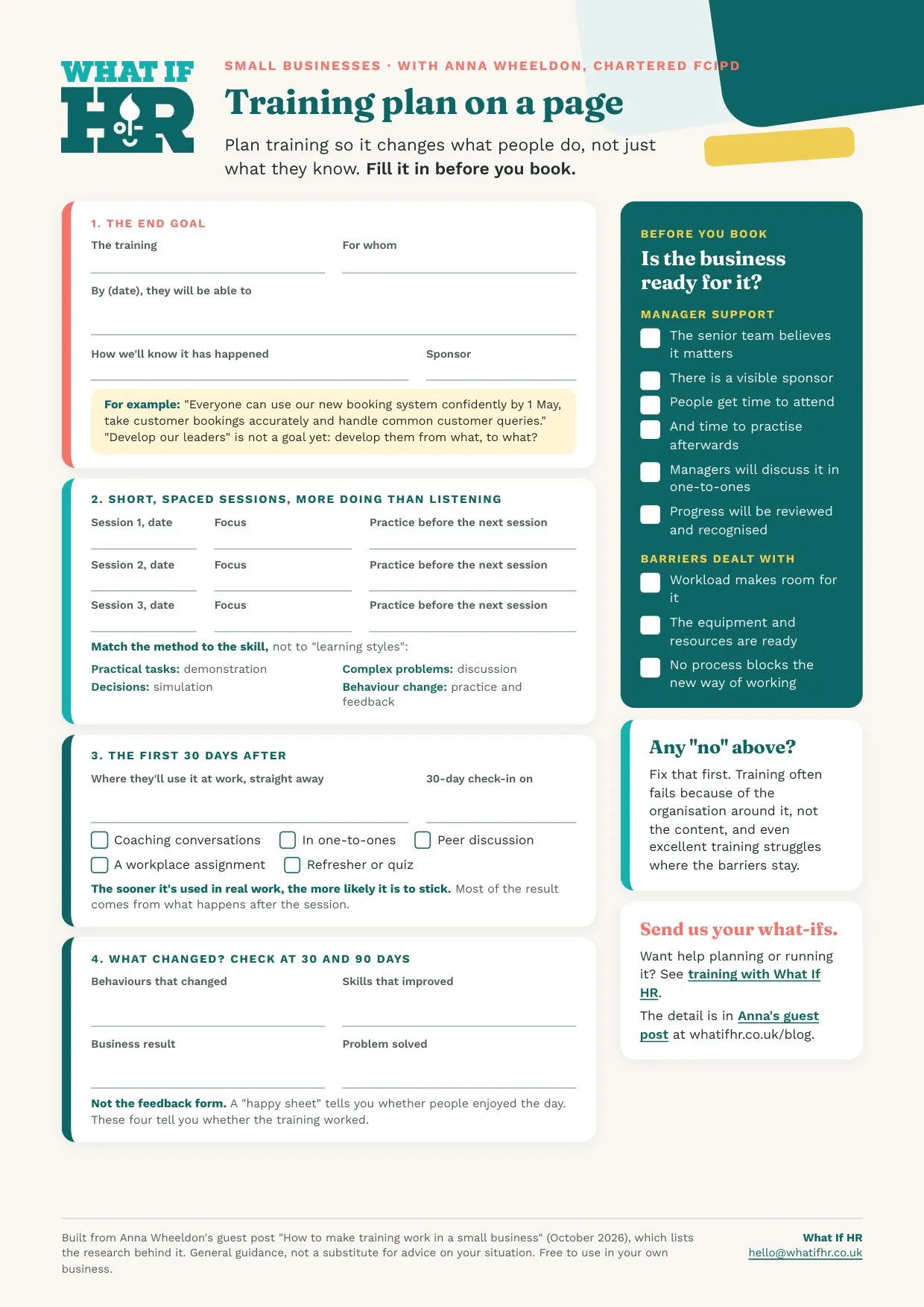
The plan, on one page. Download the PDF to fill in on screen.
Final thought
Small businesses cannot afford to waste money on training that looks good but changes nothing.
The strongest evidence tells us that successful learning is not about finding the perfect workshop or the most charismatic trainer. It is about creating the conditions that allow people to learn, practise, apply and sustain new behaviours.
Define the need clearly. Secure management support. Deliver learning in manageable chunks. Build in practice. Reinforce relentlessly. Measure outcomes.
Do those things consistently and training stops being a cost. It becomes one of the most powerful investments your business can make.
Good training is about helping people perform better, solving business problems and creating the conditions where individuals and teams can thrive.
That's the work I do with organisations. I help businesses move beyond tick-box learning and towards evidence-based development that changes behaviour, improves performance and supports long-term business success. Whether the challenge is leadership, culture, compliance, customer experience or future skills such as AI, the aim is always the same: helping people learn in ways that genuinely make a difference.
Because when learning works, businesses work better too. If you'd like to talk about training for your team, see how we run training with What If HR, or join Elena and me for a free 30-minute session on Tuesday 17 November: how to make training work in your business.
Quick answers
Why does staff training fail?
Usually because of what happens around it, not the content. Common reasons are no clear goal before the training, no time to practise afterwards, managers who don't follow it up, work overload and no measure of what changed.
What is learning transfer?
Putting what was learnt into action at work. High transfer means people now work differently. Low transfer means they attended, enjoyed it and nothing changed.
What is a training needs analysis?
The step before you book anything: what should people be able to do afterwards, by when, and how will you know? "Everyone can take bookings on the new system accurately by 1 May" is a need you can train for and check. "Develop our leaders" is not, until you say what should change.
How long should a training session be?
Shorter than most people book. Research on spaced learning favours several short sessions over a few weeks, with practice and workplace tasks in between, over one long day.
Are learning styles real?
People do have preferences, but a widely cited review by Pashler and colleagues (2008) found no convincing evidence that teaching to someone's preferred style improves what they learn. Match the method to the skill instead: demonstration for practical tasks, practice and feedback for behaviour change.
How do you measure training effectiveness?
By what changes at work: behaviours, skills, business results and problems solved. A feedback form at the end of the day only tells you whether people enjoyed it. In Kirkpatrick's well-known four-level model (reaction, learning, behaviour, results), the happy sheet is only the first level.
Is staff training a legal requirement?
Some of it. Employers must give staff the information, instruction and training they need to work safely, under the Health and Safety at Work etc. Act 1974. Employers also have a duty to take reasonable steps to prevent sexual harassment, which the Employment Rights Act 2025 raises to "all reasonable steps", and the Equality and Human Rights Commission's guidance treats training as one of those steps. Our post on the harassment duty has the details.
References
- Baldwin, T. T., & Ford, J. K. (1988). Transfer of training: a review and directions for future research. Personnel Psychology, 41(1), 63 to 105. doi:10.1111/j.1744-6570.1988.tb00632.x
- Salas, E., Tannenbaum, S. I., Kraiger, K., & Smith-Jentsch, K. A. (2012). The science of training and development in organizations: what matters in practice. Psychological Science in the Public Interest, 13(2), 74 to 101. doi:10.1177/1529100612436661
- Ericsson, K. A., Krampe, R. T., & Tesch-Römer, C. (1993). The role of deliberate practice in the acquisition of expert performance. Psychological Review, 100(3), 363 to 406. doi:10.1037/0033-295X.100.3.363
- Pashler, H., McDaniel, M., Rohrer, D., & Bjork, R. (2008). Learning styles: concepts and evidence. Psychological Science in the Public Interest, 9(3), 105 to 119. doi:10.1111/j.1539-6053.2009.01038.x
- Sitzmann, T., & Weinhardt, J. M. (2018). Training engagement theory: a multilevel perspective on the effectiveness of work-related training. Journal of Management, 44(2), 732 to 756. doi:10.1177/0149206315574596
Free downloads